

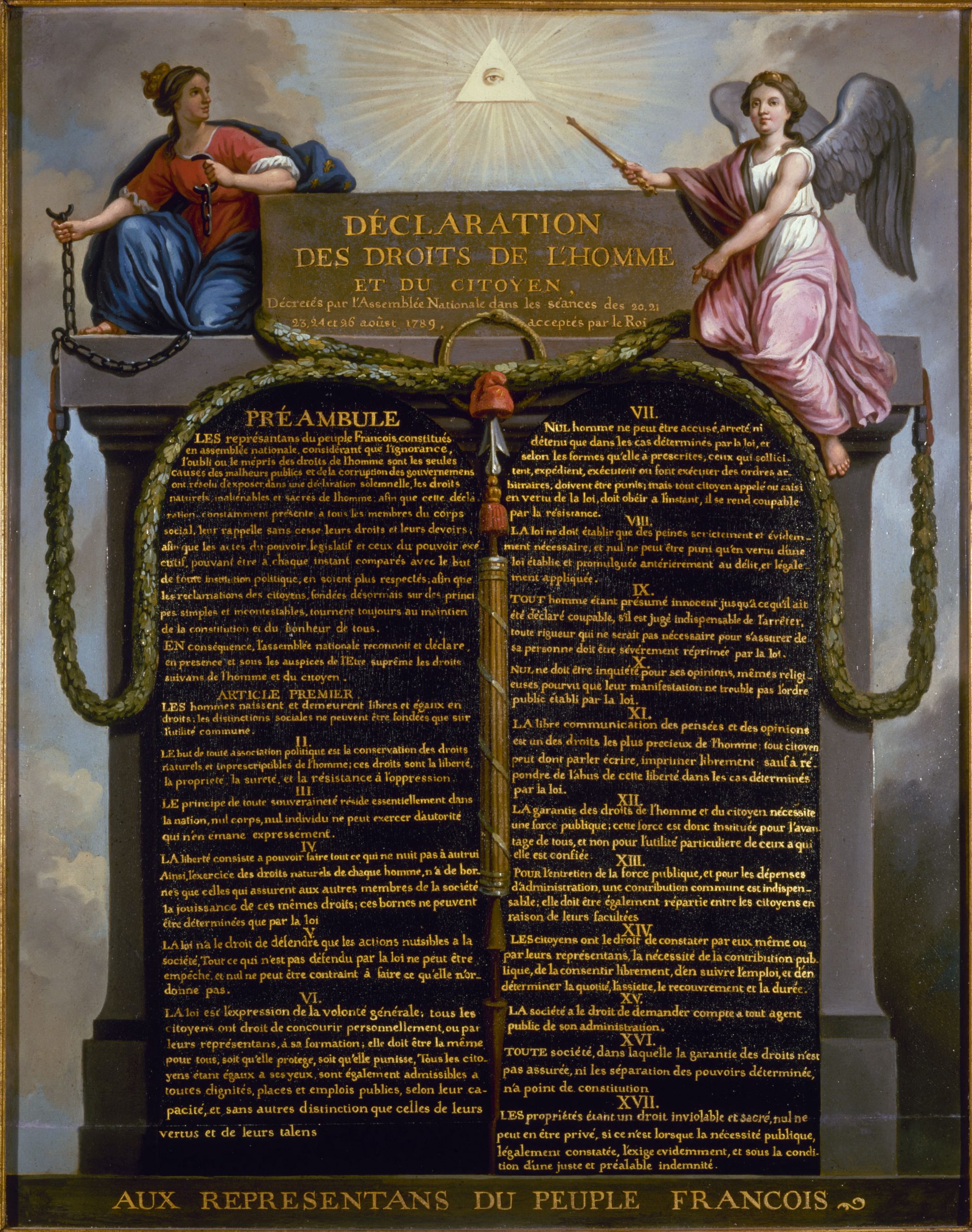
“Les hommes naissent et demeurent libres et égaux en droits.”
“All men are born and remain free and equal in rights.”
Declaration of the Rights of Man and of the Citizen, Art. 1, 1789
Who is actually arguing when German Railway is arguing with German Television?
On the philosophy of corporate personhood
On 23 July, German Public Television ZDF broadcast the documentary “Our Railways: Loved, Hated – Dangerous?” (link to the documentary). Deutsche Bahn responded, pointing out various errors and inaccuracies, which ZDF subsequently corrected to some extent. (Details here)
However, the dispute entered a second round. Last Thursday, the German newspaper F.A.Z. reported that Deutsche Bahn was demanding the article be taken down:
“Deutsche Bahn […] is entitled to corporate personality rights. It need not accept one-sided reporting.” (F.A.Z., 30 July 2026)
According to the F.A.Z., Deutsche Bahn’s lawyer refers to a ruling by the Federal Court of Justice (Case No. VI ZR 346/24). – And this is where it gets interesting.
Not only because this ruling addresses the question of at what level of support for the AfD and right-wing organisations one must accept being publicly labelled “far-right”, or because the Federal Court of Justice concludes that the term “far-right” is “negative” and “defamatory”. (For details, see here) – That in itself would be worth an essay.
No, what makes it interesting is that Deutsche Bahn’s lawyer argues that, as a commercial enterprise, the company is a legal person and is entitled to the same fundamental rights as the claimant before the Federal Court of Justice who felt his honour had been violated – although that claimant was a natural person.
By claiming fundamental rights as a legal person, Deutsche Bahn is following a long tradition: the very first public limited company to be established as an independent legal form was a transport company. And the first landmark judgements on the question of fundamental rights for companies were brought by a railway company. – But more on that later.
At first glance, the idea that a company could claim human rights seems far-fetched. The French Declaration of the Rights of Man and the American Declaration of Independence deliberately refer only to men. For Enlightenment philosophy, it was clear that only humans, as individuals and rational beings, could be the holders of rights.
However Article 19(3) of Germany’s constitution, the Grundgesetz, states otherwise:
“Fundamental rights also apply to domestic legal entities, insofar as they are applicable to them by their very nature.” (Art. 19(3), Grundgesetz)
In this regard, the Federal Court of Justice (BGH) states:
“As a manifestation of the general right of personality, the corporate right of personality protects the […] social claim to recognition of corporations as commercial enterprises[.] An infringement of the right of personality is only unlawful if the interest of the affected company that warrants protection outweighs the legitimate interests of the other party.” (Federal Court of Justice, I ZR 217/15, 2017)
If one seeks the historical roots of this perspective, one finds them in medieval canon law. At that time, individuals did not yet possess rights as of themselves – that was a concept of modern philosophy – but all rights flowed from divine sovereignty, mediated through the Church and the ruler appointed by God (through the Church). (We recall: “Paris is worth a Mass.” – Paris vaut bien une messe.)
However, even back then there were institutions such as foundations, religious orders, hospitals, guilds and universities. The question facing the Council of Lyon in 1245 was this: do such institutions have enough personality to be excommunicated – that is, to be excluded from the salvation of God mediated by the Church – if they oppose the Pope? This resembles, a little, the question the Bahn is raising: whether it has the right to be offended as a person.
The Council ruled at the time that a universitas – the technical term for such institutions – could not be excommunicated, because whilst it was a legal entity, it had no soul. Now, this says nothing about whether Deutsche Bahn or the ZDF have a soul, but in his comments on this decree, Pope Innocent IV codified two centuries of legal philosophy and distinguished between a societas, which consists solely of its members and possesses no rights of its own, and precisely that universitas, which is itself the bearer of rights.
This distinction was important for the debate within the Church: it made it possible to safeguard the Church’s assets from the claims of bishops and parish priests and to preserve them for the future. This arrangement also meant that nuns and monks lived in legal poverty, even though their orders owned land.
Modern capitalism, too, could not have existed without this distinction: the limited company is conceived in parallel to this universitas. These are legal constructs that can only be conceived because one regards an abstract entity as the bearer of rights, which takes precedence over the individuals acting on behalf of that abstract entity.
The Dutch East India Company (VOC) was founded in 1602 and is regarded as the first publicly listed limited corporation in Western history. From the outset, it enjoyed far-reaching rights, including the right to establish overseas bases, build infrastructure and maintain its own army. Crucial to the development of the private sector was the idea that Innocent IV had already conceived: the members of such companies do not act in their own name, but in the name of their companies. Consequently, their personal liability is limited. The company becomes a legal entity in its own right.
People were still very cautious about establishing such state-like corporations, but the invention of the railway and industrialisation required vast amounts of capital. And hardly anyone was prepared to put their personal assets on the line for the construction of a railway or even an iron ore mine. Consequently, more and more limited companies were permitted, and regulations were eventually relaxed entirely. Today, anyone can set up a limited liability company, regardless of the purpose. The only thing most companies are not allowed to do is set up armies. Not yet, at least.
For in the 19th century, something happened that neither Innocent IV nor Johan van Oldenbarnevelt – the provincial advocate of the Province of Holland, who had played a decisive role in pushing through the establishment of the VOC – would have anticipated. The philosophy of modernity, according to which every individual is, in and of themselves, the bearer of rights, was extended to legal persons.
In the United States, the rights to which companies were entitled were interpreted ever more broadly in the course of case law. After the Civil War, companies – led by the railways – claimed the 14th Amendment, ratified in 1868, for themselves; this amendment was actually intended to secure equal rights for freed slaves as citizens.
One such case was the lawsuit brought by the Southern Pacific Railroad (1886), which was challenging tax increases imposed by a local county. The company sought a ruling from the Supreme Court that a corporation, too, possessed civil rights. In an opening statement, Justice Waite ruled that the question was not worth clarifying – it had already been settled:
“The court does not wish to hear argument on the question whether the provision in the Fourteenth Amendment to the Constitution . . . applies to these corporations. We are all of the opinion that it does.” (Justice Waite, 1886)
And since everyone shared this view, between 1868 and 1912 over 300 cases involving corporations were heard in relation to the 14th Amendment, but only 28 cases involving Black Americans. More recent history shows that these rights are constantly being extended. In the US, corporations have the right to free speech (Citizens United v. FEC, 2010) and the right to freedom of religion (Burwell v. Hobby Lobby, 2014). The right to free speech grants them extensive influence over the funding of political campaigns. – Some American scholars are already asking when they will be granted the right to bear arms.
We live in a world in which the rights of corporations are treated in the same way as the rights of individuals. Looking at the historical development, one gets the slight impression that we have stumbled into this situation: a Pope’s notes on a conciliar decision, a statement by an American judge that this was not even a question, and finally Article 19(3) of the German Grundgesetz, for which there is no precedent in the Weimar Constitution and about which the minutes of the Parliamentary Council say very little.
In contrast to the US, case law in Germany and France still follows the principle established by Innocent IV that a universitas has no soul. Consequently, French case law rejects the right to privacy for companies. And German case law refers only to Article 2 of the German Grundgesetz (liberty to act), not to Article 1, which protects human dignity.
But the problem with all this is that human rights were originally formulated as the rights of individuals vis-à-vis the state (and the Church) as legal entities. If we now grant these rights back to legal entities, which can use them not only against one another but also against individuals, we risk jeopardising one of the great achievements of the modern age. – And by that I do not mean the railway.