

“Apparently at realistic profit rates,
it doesn’t pay to keep a forest
in existence at all.”
Paul Samuelson, 1976
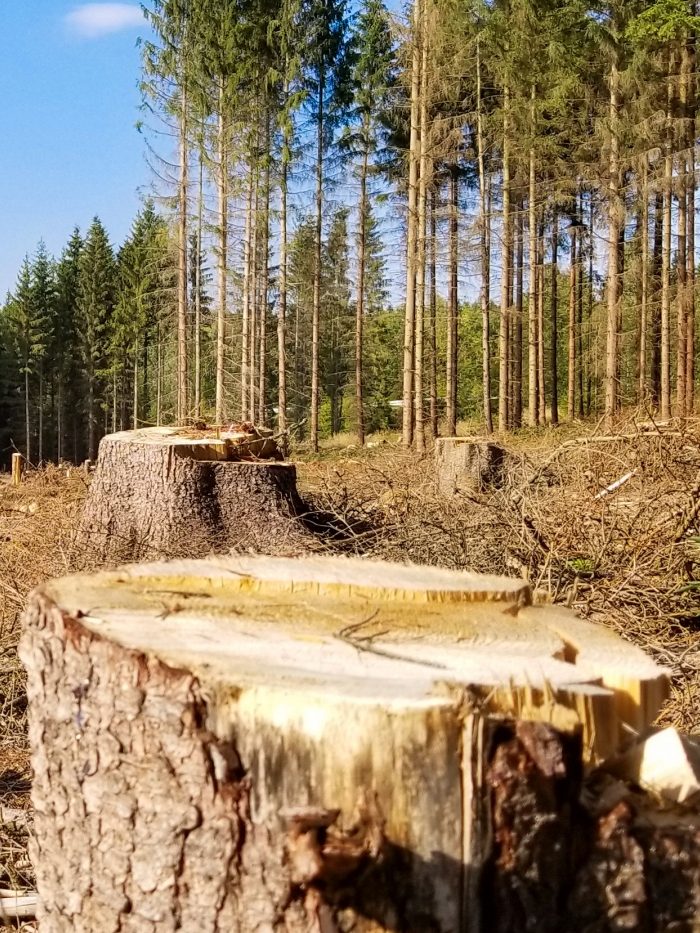
Would we still plant a tree today if the world were to end tomorrow?
Samuelson, discounting the future, and the clearing of the forests
There is a sense of doom and gloom in the air. The economy is struggling, so environmental efforts are being called into question. It is time to ask the philosophical question: would we still plant a tree today if the world were to end tomorrow?
Nobel Prize-winning economist Paul Samuelson analysed this issue in 1976 in an article on sustainable forestry. He reports on management consultants who had concluded that planting trees was not worthwhile; indeed, to optimise returns, one would have to fell the trees before planting them.
Optimising yield
Ask forestry scientists about the maximum sustainable yield of a forest, and they will point to a specific moment for felling: the point at which a tree’s expected growth in the coming year falls below its average growth so far.
From that moment on, a newly planted tree will produce more wood per year over its life cycle than the old tree would add in its next year of growth. Harvesting at that time maximises total timber yield over the long run.
Optimising financial return
Economists, however, think differently. For them, biological growth is only part of the story. Opportunity costs—captured in the discount rate of an investment calculation—matter just as much.
Following this logic, a tree should be felled as soon as its growth rate no longer exceeds the market interest rate. Since nature rarely outperforms capital markets, this reasoning implies that it would almost always have been better to fell the tree last year and invest the proceeds in a balanced ETF.
That is the logic Samuelson attributes to these management consultants.
Deforestation as a consequence
This logic came to dominate economically driven forestry from the dawn of the modern era, when timber was needed for shipbuilding, through early industrialisation, when wood fuelled energy production and iron smelting. The result was predictable: vast forests in Europe and North America disappeared.
Sustainability, on its own, was not profitable enough.
This was economically rational then—and it remains so today. The ongoing destruction of primary forests is the empirical proof.
The fear of death as the cause
At its core, the problem lies in how economics treats time. Something available today is valued more highly than the same thing available tomorrow. This reflects a simple fact: I will not live forever. As I might die tomorrow, income today is preferred to income tomorrow.
Interest rates translate this intuition into mathematical models and produce a net present value (NPV). For very long-term investments—an oak tree takes two hundred years to mature—this NPV approaches zero.
Impending death as a counterargument
But impending death can also be interpreted differently. The closer it comes, the less relevant differences in interest rates become, because the effect of compound interest diminishes. Suddenly, even planting trees becomes worthwhile, as the gap between alternative returns narrows.
Put differently: if we die tomorrow—or if the world ends tomorrow, which amounts to the same thing—opportunity costs fall to zero. There are no longer any alternatives to choose from.
Put differently again: only if we will not see tomorrow—only if the world ends tomorrow—does it make economic sense to plant a tree today.
We could die any day.
So let’s plant trees.